Pvgo calculator — estimate the present value of growth opportunities from share price, EPS, and cost of equity for stock valuation analysis. A project can still need a different hurdle rate if its risk is meaningfully higher or lower than the overall business. If the cost of equity needs a fresh market-based estimate, Beta Stock Calculator covers the beta assumption that drives that rate. Higher operating risk usually raises the cost of equity, which can dominate WACC when equity is the largest capital source in the mix. A statutory rate, blended rate, or marginal planning rate can produce different after-tax cost of debt values in the WACC formula.
This is general information, not personalized financial or tax advice, and confirming the specific inputs, especially cost of equity and current tax treatment, with a finance professional or CPA is worth doing before using WACC in an actual investment decision. Using book value instead of market value for equity is one of the most common distortions, book value can differ substantially from what the market actually says a company’s equity is worth, throwing off the weighting between debt and equity. Use current, market-based figures for cost of equity and cost of debt rather than outdated historical rates, since capital costs shift with market conditions over time. A lower WACC indicates a company can raise capital more cheaply overall, making a wider range of investment projects potentially worthwhile since less return is needed to clear that cost hurdle.
Always build WACC from your company’s capital structure and costs, then compare to peers rather than copying a mid-range percentage. Analysts estimated Apple’s cost of equity to be around 9% and its after-tax cost of debt to be approximately 2.5%. Consider a company with a market value of $100 million in equity, $50 million in debt, a cost of equity of 5%, a cost of debt of 3%, and a corporate tax rate of 30%. Thus, companies such as American Airlines and KB Homes will have higher betas and ranges of equity cost of capital that exceed the 8% to 11% average. Thus, companies such as Kroger, Coca-Cola, and Kraft Heinz will tend to have low betas and a range of equity cost of capital below 8% to 11%. Companies that have a beta less than 1 will have an equity cost of capital that falls below this range, and companies that have a beta greater than 1 will have an equity cost of capital that rises above this range.
Investors also use WACC to value companies by discounting future cash flows back to today’s dollars. Companies use it as a hurdle rate, meaning any new project or investment should earn a return higher than the WACC. Once you fill in all the fields, the calculator will return your WACC as a percentage. This is important because interest payments on debt are tax-deductible, which lowers the true cost of debt.2 This tax benefit is called the tax shield. Business owners, students, and analysts use WACC to evaluate new projects, compare investment options, and figure out if a company is creating or destroying value. Lenders and shareholders each expect a certain return, and WACC blends those expectations into one useful percentage.
Cost of Equity using CAPM
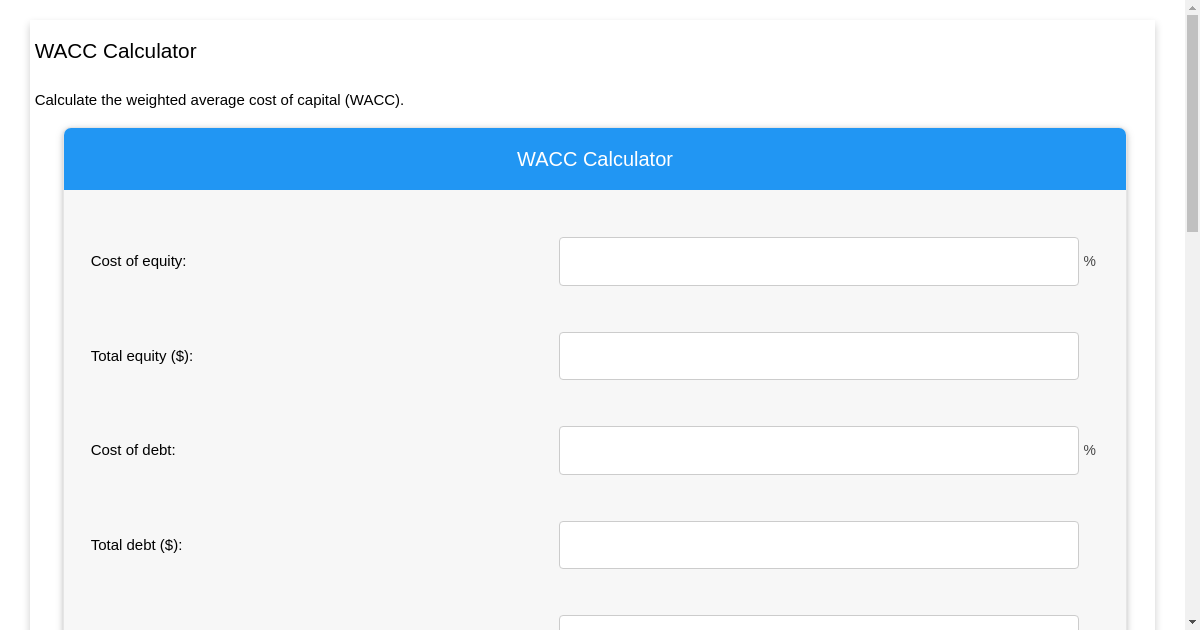
Now if you agree to the condition and borrow the loan, this what is wacc in finance interest rate is your company’s cost of capital. However, bank conditions the loan with an 8% interest that you need to pay over and above the total capital that you’d borrow. Fill the calculator form and click on Calculate button to get result here Negative inputs would give flawed results; we validate entries to avoid nonsense. Market values reflect current opportunity cost of capital, while book values are historical.
Cost of Equity
After WACC is calculated, it can be used to compare a company’s yields versus weighted average cost of capital to get an idea of how well it utilizes its capital assets. It is based on the amount of equity, debt, cost of equity, cost of debt, and the corporate tax rate. According to SEC Investor.gov, weighted average cost of capital is a blended financing cost used to describe how a company funds itself through debt and equity. Equity is $8,000,000, debt is $2,000,000, preferred stock is $0, cost of equity is 11%, pre-tax cost of debt is 5.5%, and the corporate tax rate is 25%. It depends on the values you enter and the assumptions behind the cost of equity, the pre-tax cost of debt, and the corporate tax rate. You need the market value of equity, market value of debt, cost of equity, pre-tax cost of debt, and corporate tax rate.
WACC serves as the hurdle rate for evaluating investment projects. WACC (Weighted Average Cost of Capital) is the average rate a company pays to finance its assets, weighted by the proportion of debt and equity in its capital structure. Enter the cost and market value of equity and of debt, and the corporate tax rate. MiniWebtool’s WACC Calculator weights the costs of equity and debt by their market values, including the assumed debt tax shield. If, for example, a household has multiple loan options available (with different costs), they can use a modified version of the WACC formula to determine what their average cost of borrowing will be.
As a result, the weighted average may vary when market prices do since the WACC multiplies the market value by the real cost of each capital source. This valuation method helps investors assess whether a company’s stock is undervalued or overvalued relative to its expected future cash flows. By discounting future cash flows at the company’s WACC, analysts can estimate the intrinsic value of the company’s equity. Understanding how to calculate WACC and applying it effectively enables you to measure investment feasibility, compare projects consistently, and ensure returns justify financing costs. In Beta Corporation’s case, calculating WACC helped us determine the correct discount rate for computing NPV.
WACC Calculator with Beta
A 5% WACC means investors and lenders require about 5% per year on average to fund the firm, common for low-risk, regulated, or highly rated businesses in a low-rate environment. Free APY calculator & high-yield savings calculator, grow HYSA savings, convert rate to APY, compare accounts, chart, CSV/PDF export. Model compound growth, compare scenarios, and solve savings goals. Discover more calculators for time tracking, payroll, and HR. Document assumptions, use market-like weights, and cross-check against industry ranges and peer transactions rather than a single point estimate. For cost of equity, analysts often use CAPM with a peer-group beta (re-levered to the private company’s capital structure) plus a size or illiquidity premium.
Private firms lack a public market cap, so equity value (E) is usually estimated from recent funding rounds, 409A appraisals, comparable public multiples, or a DCF loop. The sum of discounted cash flows plus terminal value gives enterprise value; subtract net debt to reach equity value. A ±1 percentage-point move in WACC can shift enterprise value by 10%–20% in many DCF models, especially when terminal value is a large share of the total. Lower-risk, regulated, or asset-heavy sectors often sit at the bottom of these bands; high-growth or cyclical businesses tend toward the top.
The weighted average cost of capital calculator or WACC calculator allows you to determine the profitability your company requires for it to create value. The result gives the weighted average cost of capital with each part’s weight and contribution. These include total equity, cost of equity, total debt, cost of debt, and the corporate tax rate. Calculate the weighted average cost of capital (WACC) by entering the equity and debt below. Since there are many possible proxies for each element in the cost of capital formula there might be a fairly large range of defensible WACC analyses as result.
These benchmarks are aggregated from Damodaran’s annual industry cost of capital data for US companies. This is the discount rate for a DCF model of Acme’s free cash flow to the firm, and the hurdle rate for evaluating new investments. The effective after-tax cost of debt is rD × (1 − t). WACC is the blended required rate of return across all sources of financing a company uses — primarily equity and debt, sometimes preferred stock. Provides the foundational discount rate required for discounted cash flow (DCF) enterprise valuation. Calculates hurdle rates based on risk-free yields, levered equity betas, and equity risk premiums.

Use the information provided by the weighted average cost of capital calculator critically and at your own risk. It is “the weighted average of the costs of equity and debt” and reflects a firm’s cost of capital acquisition as well as its capital structure. There are several ways to write the formula for weighted average cost of capital. So, how does one calculate weighted average cost of capital?
As a 360-degree virtual CFO, Shekhar has streamlined accounting processes and managed cash flow to ensure businesses remain tax and regulatory compliant. For real estate businesses, properties are often financed with debt. For instance, if you compare Tech, Financial Services, and Real Estate companies, each of these industries have their own distinct WACC. Generally, companies which come at a higher risk also have an increased cost of debt. This measure also gives your company’s investors an idea of the risk level compared to other companies. In any company, the cost of debt is one aspect of its capital structure.